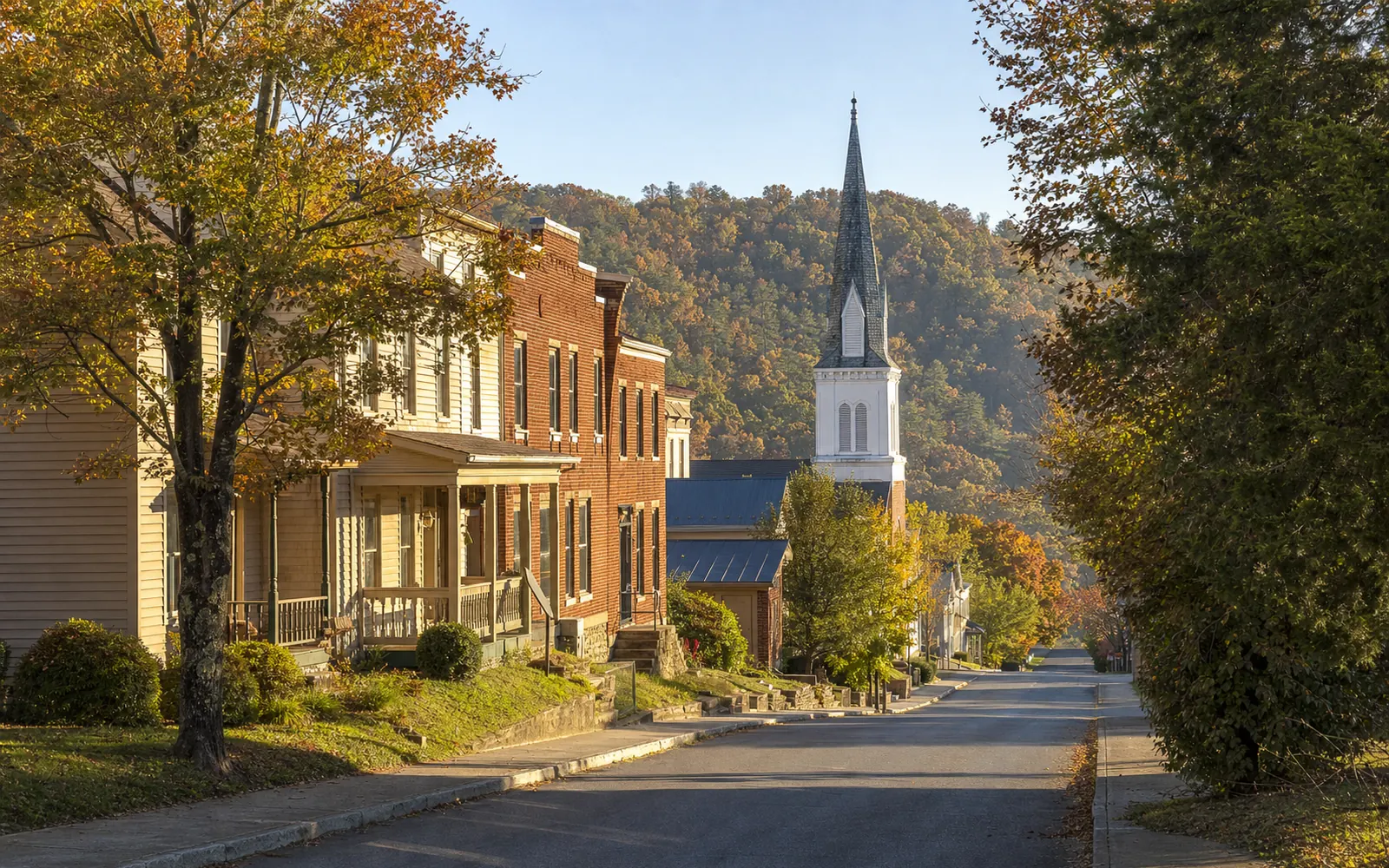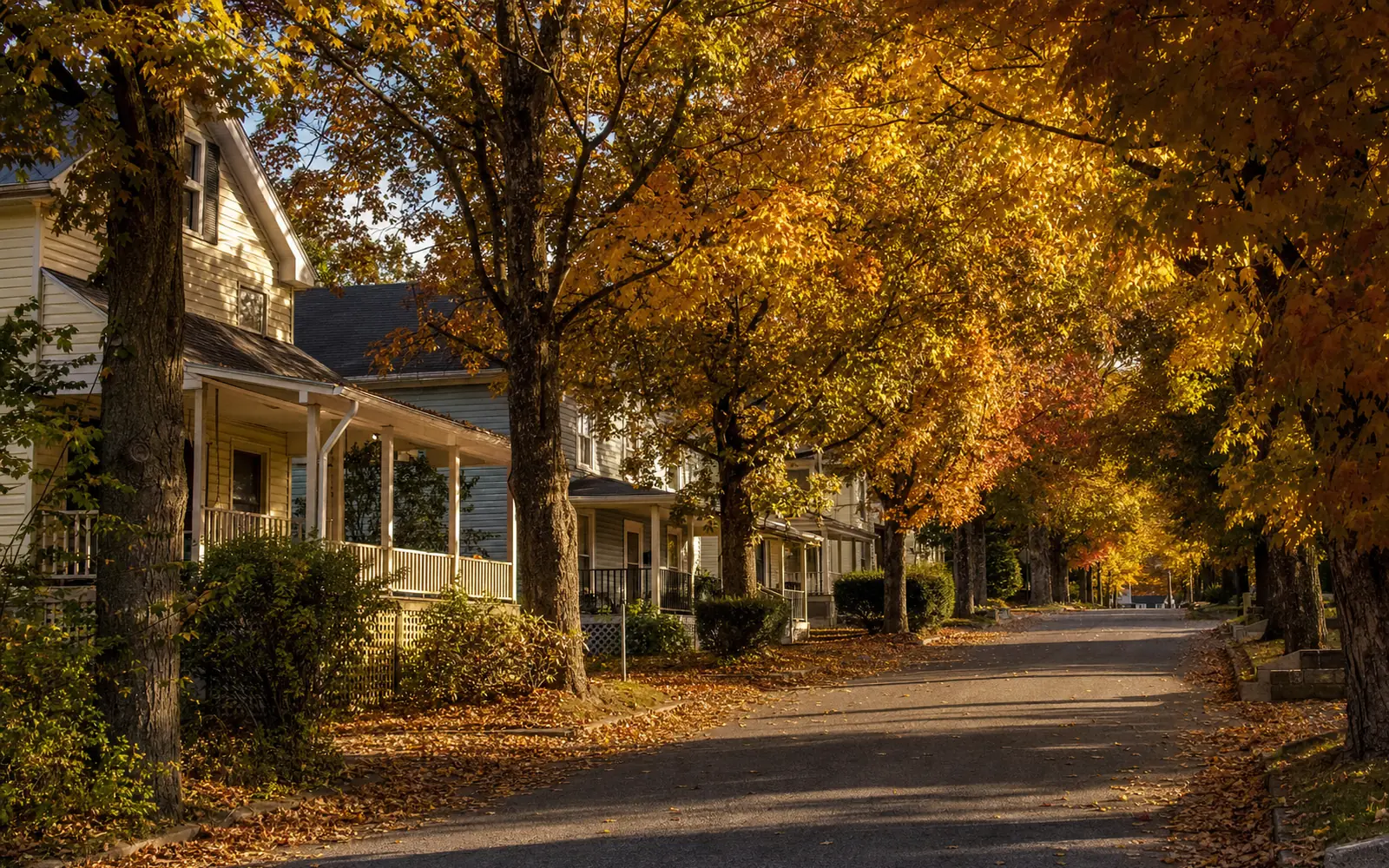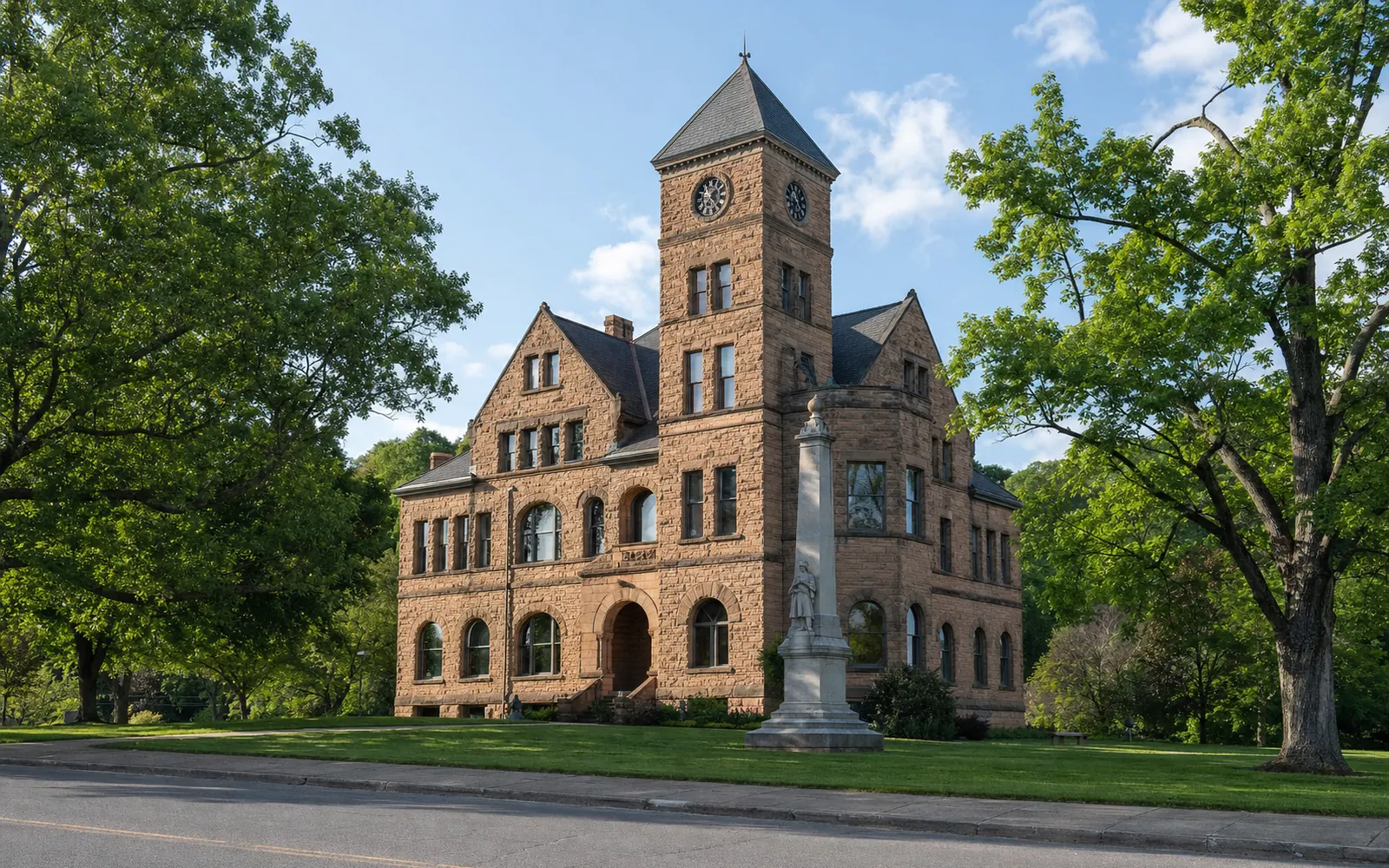
Before the climbers and the coffee shops, Fayetteville was a farm called Vandalia, owned by Abram Vandal, and it became the seat of Fayette County in 1837, when the town was platted and renamed for the county and the Marquis de Lafayette. In the Civil War it was a garrison town that both armies occupied. The Battle of Fayetteville was fought here on September 10, 1862, and by 1865 no more than six buildings were left standing. The handsome courthouse you see on Court Street today was begun in May 1894 and accepted by the county on November 22, 1895.
The best part is that you can still walk this history. Union earthworks, a Romanesque courthouse with carved faces on its pilasters and a downtown historic district of more than a hundred old buildings are all within a few blocks of your lunch table. The details below come mostly from two National Register nominations, the 1990 one for the Fayetteville Historic District and the 1977 one for the courthouse, and both are well worth a browse.
How did Fayetteville get its name?
Fayette County was formed on February 28, 1831, from parts of Kanawha, Nicholas, Greenbrier and Logan counties, with its first seat at New Haven on the north side of the New River. Three places wanted to be the seat, New Haven, Vandalia and Falls of Kanawha, and the question was eventually settled "in favor of Vandalia."
Vandalia was "named for Abram Vandal, who acquired the property from a man named Reed between the years of 1818-1825," the 1990 nomination explains. The seat came down to a vote of freeholders, and the county clerk, Hiram Hill, gave the result a friendly nudge: he "gave away a number of one acre tracts, without any specific boundaries, qualifying the holders to vote." The courthouse site itself was "near a dead chestnut tree in Abram Vandal's rye field."
In 1837 Vandal deeded everything to his son Edward, and Deed Book C records a plan of "Fayetteville" laid down that year by Francis Tyree. The first courthouse went up in 1838. The town sat on the Giles, Fayette and Kanawha Turnpike, the road from Pearisburg, Virginia through Raleigh Court House (now Beckley) to the Falls of Kanawha. A bid in 1893 to move the county seat to Montgomery failed. By the 1880 census, the district called "Fayetteville #1" counted 472 people.
The town's incorporation date depends on who you ask. The town's own history page and its 2024 comprehensive plan give November 21, 1872, while the 1990 nomination and the West Virginia Encyclopedia give May 24, 1883, "with W. W. Wiseman as mayor."
What happened in Fayetteville during the Civil War?
The county's Confederate sympathies showed early. On May 18, 1861, three days after Virginia's secession vote, Confederate militia mustered in Fayetteville with Brig. Gen. Alfred Beckley present and a dinner at the courthouse. That year's county resolutions pledged money to resist what they called "a hostile army of Northern Fanatics," and closed with a line that still jumps off the page.
"We will eat roots and drink water and still fight for our liberty unto death."
Militia dug fortifications around the town and at Cotton Hill through the summer and fall of 1861, and Robert E. Lee commanded in the county that fall before the Confederates pulled out of the New River area in November. The first Union troops arrived on November 14, 1861 to find the town nearly empty. The 23rd Ohio under Lt. Col. Rutherford B. Hayes, 1,430 men, wintered here and called the post Camp Union, and the future president wrote that it was "much the best place we have been in." Union troops held the town from November 14, 1861 to March 12, 1862, again from November 12 to 15, 1862, and from May 17, 1863 onward, and it changed hands several times in between.
The Battle of Fayetteville, September 10, 1862
Union troops built Fort Scammon on Fort Hill in 1862, and its site went on the National Register in 1976. On September 10, 1862, a Confederate force of about 5,000 under Loring drove Col. Edward Siber's Union brigade of about 1,200 out of town. Union losses are commonly put at 139 (16 killed, 69 wounded and 54 captured or missing) and Confederate losses at 88. Siber slipped away over Cotton Hill after midnight. The fight opened a Kanawha Valley campaign that ended with the Union pulling back to Ohio, until Union troops returned from Maryland in October and the Confederates left the valley. The West Virginia Encyclopedia's entry on the Loring raid tells the wider campaign.
By December 18, 1862, a correspondent for the Ironton Register found the village "almost depopulated having only one family living there," with Gen. Scammon quartered in a new brick house. Union soldiers raised more earthworks in 1863, including Fort Toland, probably the same earthwork as the "Fort Buefort" on Maple Avenue. A house on East Maple Avenue is "built on a part of Fort Scammon, some of which can still be seen today," the 1990 nomination says; it's private land, so enjoy it from the street.
Was the first indirect artillery fire in Fayetteville?
It's the town's favorite Civil War claim, and it comes with an argument attached. In May 1863, Confederate Milton W. Humphreys of Bryan's Battery fired a howitzer at the Union position from behind a wooded ridge, working out the aim by calculation with a spotter on a nearby hill. Ben Crookshanks, writing in America's Civil War, says Humphreys fired 65 rounds over two days at the fort about a mile away, and WV Explorer adds that he was 18 and that the howitzer was nicknamed "Maggie."
A state marker put up in 1979 credits him with the first use of indirect fire, and the West Virginia Encyclopedia says the shot "set a precedent for modern warfare." The town's own 1990 National Register nomination scoffs: "Although this is an obvious historical fallacy, it remains firmly a part of local 'historical' lore." Humphreys, who went on to teach the classics at Washington and Lee, Vanderbilt, Texas and Virginia, didn't claim it either: "I claim no credit for the 'invention'; the thing is so obvious." The fair version is that the 1863 shot happened and was documented. Whether it was the first is still up for debate, which makes it a great one to argue over dinner.
From May 1863 the town stayed in Union hands for the rest of the war. By 1865 the courthouse was gone and "from two or three buildings to not more than six buildings" remained. The courthouse well is said to have served both armies, and Fort Scammon and the Fort Toland site are contributing sites in the historic district.
When was the Fayette County Courthouse built?
Construction began in May 1894, and the county formally accepted the building on November 22, 1895. (You'll sometimes see 1897, which is really the date of the Altamont Hotel.)
It was the county's fourth courthouse. After the war "a second courthouse was soon erected," and in 1887 it was replaced by a brick and stone building by Baltimore architect Frank Davis. That one burned in April 1893, "a double disaster ... in terms of lost space and documents." After a design competition, the plans of Wheeling architects Edward Bates Franzheim and Millard F. Giesey were accepted and "paid for at the stipulated sum of $750." Murray Brothers of Wheeling built it on a contract that came to $58,297.25, reusing brick and stone salvaged from the burned building.
Take a slow lap around the outside. It's a two-and-a-half-story Romanesque building with a rock-faced sandstone base, brick above, a patterned slate roof and a square tower with a belfry, and the carved capitals on the chimney and dormer pilasters show animals and human faces. Inside is a cast-iron open-well stair. The 1977 nominator was hard to impress ("not outstanding in terms of style or construction, but it is a good example and detailing is excellent"), but the detailing really is the fun part. Listed on its own in 1978, it's still a working courthouse at 100 North Court Street, open weekdays 8 AM to 4 PM with security screening, so treat it as a place of business rather than a museum.
After the war: coal, the railroad and a historic district
The Chesapeake and Ohio finished its line through the gorge in 1873, and the town's growth "accelerated" after that, the West Virginia Encyclopedia says. Fayette County led the state in coal production from 1888 to 1903, and its population rose from 6,647 in 1870 to 60,377 in 1920. Most of downtown went up between 1900 and 1930, and the town "declined after 1950" until a new kind of visitor came along. The mining towns in the gorge below have their own story in the coal towns of the gorge.
The Altamont Hotel on Fayette Avenue went up in 1897 and 1898 and became apartments in the 1930s. The Fayetteville Historic District, listed on December 20, 1990, takes in the downtown bounded roughly by WV 16, Maple Avenue and Fayette Avenue, with more than a hundred historic buildings and periods of significance from 1825 to 1949. It makes a fine slow walk between coffee and dinner. The bridge that later reshaped the town gets its own telling in the bridge and Bridge Day history, and the town today is in about Fayetteville.
Civil War sites to visit near Fayetteville
Carnifex Ferry, in Nicholas County, is the closest battlefield park, a quiet green spot where it takes a little imagination to picture the fighting. On September 10, 1861, Union Gen. William S. Rosecrans attacked Confederate Gen. John B. Floyd, entrenched on the Patteson farm, and Floyd withdrew across the river that night. The state park's 156 acres are open 8 AM to 8 PM; its museum ran on weekends and holidays through Labor Day in 2026, so check before you go in the off-season. Gauley Bridge "was taken and retaken three times" in 1861 and 1862, the West Virginia Encyclopedia says, and its wooden bridge "was burned, rebuilt, and burned again." On Sewell Mountain, Lee set up headquarters in the 1861 campaign and first saw the horse later called Traveller, though he bought him in 1862.
In Ansted, Contentment, a house of about 1830 enlarged by former Confederate Col. George W. Imboden, is the museum and headquarters of the Fayette County Historical Society; call ahead for hours. The Midland Trail day trip strings Ansted and Gauley Bridge together into an easy afternoon. Park rangers also bring the war to life: the free "Crossroads of Conflict" talks at Canyon Rim Visitor Center on September 19 and 20, 2026, covered by WOAY, told the story of the fighting in the gorge, so keep an eye on the park's calendar for the next round.