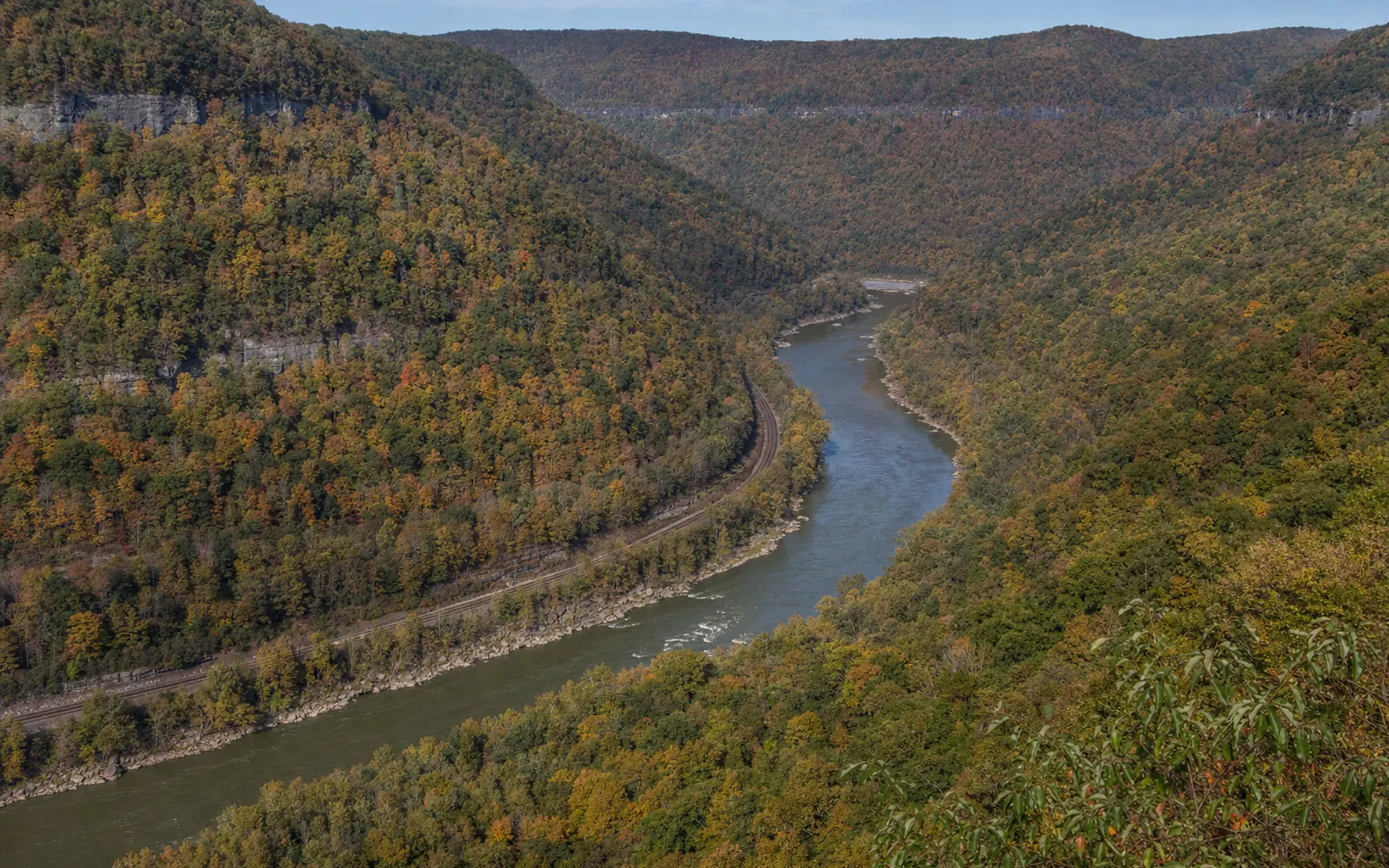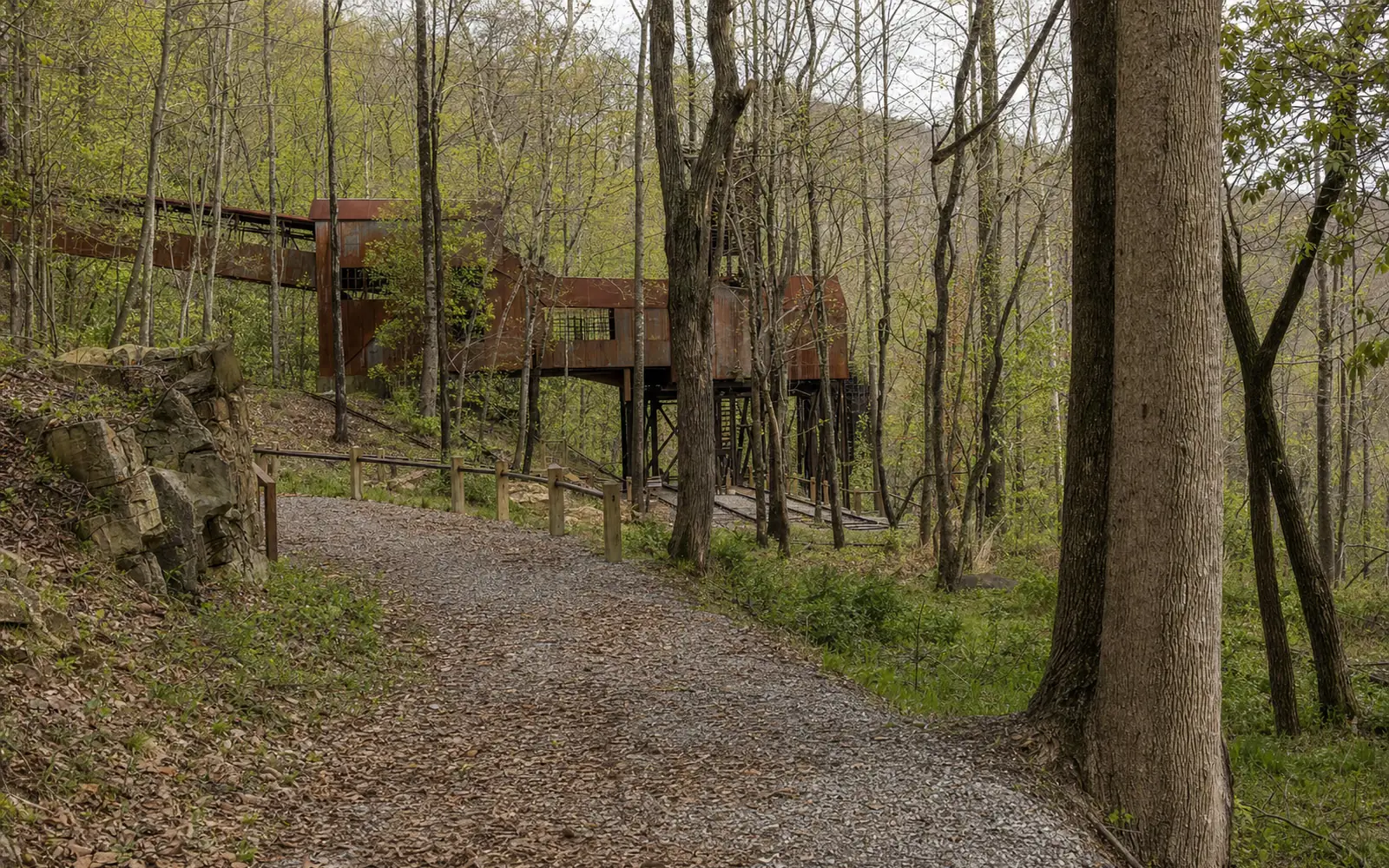
Under a century of regrown forest, the New River Gorge is hiding whole towns: a steel conveyor climbing the slope at Nuttallburg, a mine tipple at the bottom of 821 steps at Kaymoor, and Thurmond's brick row still standing beside the tracks. Mining here took off when the Chesapeake and Ohio Railway finished its line through the gorge on January 29, 1873, and the first load of "New River Smokeless Coal" left Quinnimont that fall. For about ninety years company towns lined the river, with Thurmond hauling their coal to market, until Kaymoor closed in 1962.
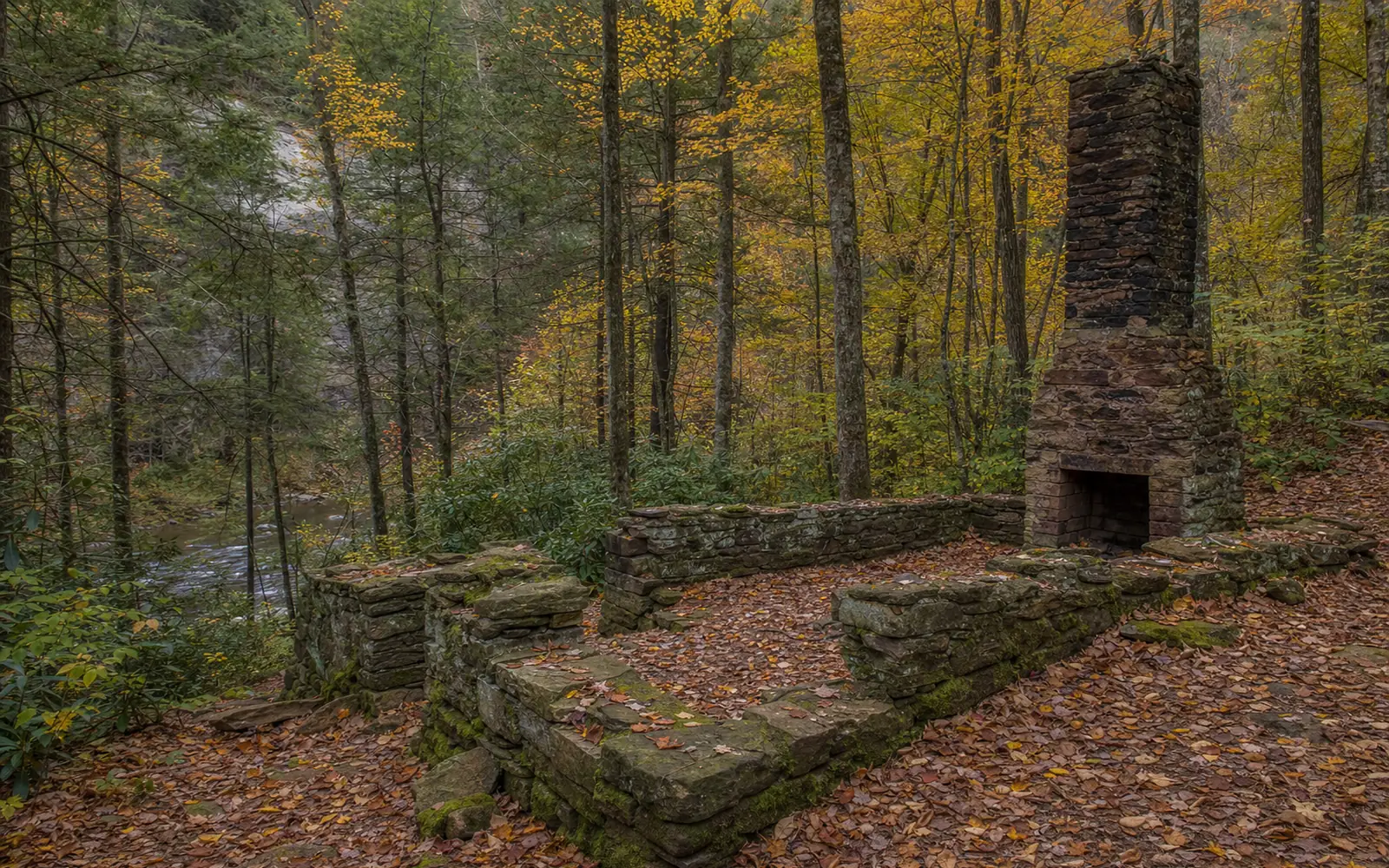
"More than 70 coal camps and railroad towns with African American populations once dotted the New River landscape," the Park Service says, and "only a handful remain today." Nuttallburg and Kaymoor are the two you can walk right into. Most of the rest are foundations and lone chimneys in the trees, which is its own kind of thrill when one appears beside a trail.
Where did New River Gorge coal mining start?
At Quinnimont, "the oldest European settled town in the New River Gorge" by the Park Service's reckoning, settled by Jacob Smith in 1827. Joseph L. Beury, a Pennsylvania coal operator's son and Civil War officer, opened the New River Coal Company mine there in 1872, and in 1873 he "became the first coal owner to ship 'New River Smokeless Coal' to the world." His associates later raised a 25-foot granite monument in a field beside what is now the CSX yard, inscribed to "Joseph Lawton Beury in 1873," and you can spot it from WV 41. For the big picture, stand at the Main Overlook at Grandview and look down on Quinnimont itself.
What followed was a genuine boom. Fayette County led West Virginia in coal production from 1888 to 1903, and its population leapt from 6,647 in 1870 to 60,377 in 1920, according to the West Virginia Encyclopedia.
Plenty of smaller towns came and went. Fire Creek, dating to 1873, was among the first to turn coal into coke. Beury's own town topped 500 residents by 1900 and had a 23-room mansion, now "buried under rubble after a flood in 2001." Sewell, served by the Mann's Creek Railroad from 1886 to 1955, had 193 beehive coke ovens, and WV Explorer says more than 50 still survive. Elverton ran from 1898 to 1951; during a 1914 strike, "over 200 rounds of ammunition" were fired at its company store. For the easiest ghost-town walk in the gorge, take the Southside Trail, a mostly level old railroad grade that runs 7.0 miles from Cunard past the ruins of Red Ash, Rush Run and Brooklyn.
Nuttallburg: the best-preserved coal town in the gorge
If you only see one, make it Nuttallburg. The Park Service calls it "one of the most intact examples of a coal mining complex in West Virginia," and the showpiece is the 1,385-foot conveyor that climbs from the tipple up the gorge wall, stabilized along with the tipple in 2011. Wander the town site and you're walking among the foundations of a place that had about 500 residents in the 1920s, two schools, two churches, a powerhouse, a store, a clubhouse and its own water system.
John Nuttall, born in Accrington, England in 1817 and working in the mines from age 11, started buying land here around 1870 and was ready to ship the moment the railroad opened in 1873. His became the second town in the gorge to ship smokeless coal, and the 1890 census counted 110 company-owned houses.
Short Creek split the town by race. "Blacks lived on the east side of the creek; whites lived on the west side," the Park Service's Nuttallburg history says plainly, and each side had its own school, church and clubhouse. The Black company school taught grades one through eight for five or six months a year. In 1900 African Americans were more than 55 percent of the town, most of the men miners.
Then came a famous name. In the 1920s Henry Ford's Fordson Coal Company ran the mines, under a lease by the Park Service's account and as owner by the county visitor bureau's. Either way Ford was gone by 1928, having found he "could neither control, nor afford to buy, the railroad." Production ended in 1958, and the Nuttall family handed the site to the Park Service in 1998.
Getting there is half the adventure. Keeneys Creek Road is "narrow, winding, steep; partially gravel," the Park Service warns, and no place for big vehicles or trailers; the alternative is the steep 0.75-mile Headhouse Trail from the Short Creek trailhead off Beauty Mountain Road. The road washed out in the August 15 and 16, 2026 floods and reopened by September 3, WVNS reported, though the Keeney's Creek Rail Trail above the Conveyor junction was still listed closed.
Kaymoor: 821 steps down to a coal mine
Kaymoor is a workout with a payoff. The Kaymoor Miners Trail drops about half a mile below the rim to the upper mine, then a staircase of 821 steps, built in 1994 and rebuilt in 2023, takes you down to the tipple. Allow two to four hours, and save some legs for the climb back up.
The Low Moor Iron Company opened Kaymoor in 1899 on land A. A. Low had bought in 1873, naming it for superintendent James Kay, and the first shipments in 1900 came to 28,074 long tons. The mine worked two levels, Kaymoor One and Kaymoor Two, joined by 1,000-foot inclines at 30 degrees. Its row of beehive coke ovens grew from 120 to 202 during World War I before "all closed in the 1930s due to obsolescence." The mine was sold in 1925, Kaymoor Bottom was abandoned in 1952 and the seam gave out in 1961. By the time Kaymoor closed in 1962 it had produced 16.9 million tons, and it went on the National Register in 1990.
One of the gorge's young miners became famous for something else entirely. Carter G. Woodson, later called the father of Black history, spent "six long years" in gorge mines, Kaymoor and Nuttallburg among them, before starting high school at 20.
Plan around the repairs: in 2026 the upper trail is closed Monday to Thursday until November 19 and open Friday to Sunday. On weekdays you can still reach the mine site from Fayette Station Road on the Kaymoor Trail.
The dangerous side of coal: disasters and labor fights
The ruins are peaceful now, but the work was deadly. The Park Service's list of gorge disasters names three mine explosions. At Red Ash near Thurmond on March 6, 1900, 46 men died after a trap door was left open and lamps ignited methane, most of them killed by afterdamp. On March 18, 1905, 24 died in the connected Red Ash and Rush Run mines when a cart ran over loose explosives and a second blast caught the rescuers. The worst was Layland No. 3 near Quinnimont on March 2, 1915: 112 dead, 111 of the 164 men underground and one bystander. Explosions at Parral in 1906, Stuart in 1907 and Eccles in 1914 added to the toll.
The January 1880 coal strike at Hawks Nest (not the later tunnel disaster) was "the first coal strike in which the state used its troops to keep order," the West Virginia Encyclopedia says, a move repeated in 1894, 1902 and 1912. Mother Jones served as the United Mine Workers' first walking delegate in the state and was jailed here in 1902, at 71, and again in 1913.
Thurmond, the town that shipped the coal
If the mining camps were the engine, Thurmond was the cash register. W. D. Thurmond, a surveyor who had led Confederate partisan rangers, took 73 acres at the river as payment for surveying in 1873, the year the railroad opened. Only one house stood there until the C&O bridged the New in 1888 and 1889. Then the rail yard grew with the branch to Glen Jean, and the town filled in beside the tracks: a hotel in 1891, the 35-room Thurmond Hotel in 1901, the depot and the Mankin-Cox Building in 1904, and an Armour meat plant in 1906. Across the river, Thomas McKell built the hundred-room Dun Glen hotel in 1901, and the two sides kept very different rules.
"On Thurmond's land, there was no liquor, not even at the La Fayette Hotel. On McKell land, liquor was welcomed."
The money was staggering for a town this small. "By 1910, Thurmond produced $4.8 million of freight revenue for the C & O, almost 20 percent of its revenue, ten times more than Richmond and 2 1/2 times more than Cincinnati," the same nomination says. The census counted 315 people in 1910 and a peak of 462 in 1930. Then the slide: fires in 1922 and 1930 (the second took the Dun Glen on July 22), bank failures in the 1930s, Armour's move to Beckley in 1932 and diesel locomotives from 1949. Historian Kyle McCormick summed it up as "good roads and a bad name." That name lives on in the West Virginia Encyclopedia's record of the town's reputation, "hell with a river through it," along with the legend of a poker game at the Dun Glen that supposedly ran for 14 years. Film fans may recognize the place, too: John Sayles used Thurmond as the stand-in for Matewan in his 1987 film.
Thurmond is still an incorporated town, with a handful of residents, beside an active CSX line. The Park Service restored the depot as a visitor center in 1995; in 2026 it opens weekends only from September 12 to October 25, then closes until May 26, 2027. The town is also in a fight with the park. NPS plans to demolish a set of park-owned structures in and near Thurmond, tentatively from November 2026, with counts in the press ranging from 12 out to bid to about 20 slated. The council voted on August 11, 2026 to seek counsel and act as plaintiff, Bailey & Glasser agreed on September 5 to represent the town without charge, and on September 16 WOAY reported the plan was "accelerating" and that demolition "could begin as soon as November." No lawsuit had been reported filed as of September 22. The depot and the Commercial Row buildings are on no published demolition list. The full account is in the Thurmond demolition story, alongside the other stories from the town and the gorge. Hours, directions and train-safety tips are on the Thurmond visitor page.
The Whipple Company Store and company scrip
Outside the park at Scarbro, the Whipple Company Store shows better than any museum how a company town took its wages back. Built around 1900 for Justus Collins's Whipple Colliery Company, it looks octagonal from the front, though its National Register form notes a six-sided first floor. It sold groceries, hardware, clothing, furniture and coffins, and wages were "often paid in scrip," WV Explorer says. It served as the company store until the mine closed in August 1957 and was listed on the National Register in 1991. Its museum status is unsettled: the Preservation Alliance of West Virginia marks it "Saved" after a 2018 sale, while other listings describe the museum as closed. Plan on admiring it from the road unless you've confirmed a tour.
African American heritage in the New River Gorge
By 1909 African Americans were more than 26 percent of West Virginia's mine workers, and about three-quarters of Black miners were coal loaders earning $2.20 to $5.00 a day, as the Park Service's page on the miners of Helen tells it. The National Parks Conservation Association reported in 2017 that mine owners "intentionally segregated company housing in an attempt to prevent unionizing."
You can trace this history on the road. The park's African American Heritage Auto Tour covers 17 sites in four counties, from Quinnimont's Missionary Baptist Church and Nuttallburg to Camp Washington-Carver at Clifftop, which opened on July 26, 1942 as the first statewide 4-H camp for African Americans in the country; ask at Canyon Rim for the current version of the tour. DuBois on Main Museum in Mount Hope, home of the segregated DuBois High School, opens Tuesday, Wednesday, Friday and Saturday, 11 AM to 5 PM, free, per its tourism listing. The Park Service's oral history project indexes interviews on mining, railroading and African American life in the gorge.
Coal heritage beyond the park
Want to go underground? The Beckley Exhibition Coal Mine shipped its first coal in 1906, became an exhibition mine in 1962, and in 2026 runs rides guided by veteran miners daily from April 1 to November 1. It's always 58 degrees inside, the city says, so bring a jacket even in July. The National Coal Heritage Area, created in 1996, covers 13 counties including Fayette and Raleigh, and its Coal Heritage Trail runs 187 miles from Bluefield to Ansted.
And then there's John Henry. At the Great Bend Tunnel near Talcott, completed in 1872 on the C&O's line, the West Virginia Encyclopedia concludes that "a man like John Henry in fact beat the steam drill," though some doubt he existed and historian Scott Reynolds Nelson has argued he worked at a different tunnel in Virginia.
The gorge towns are all inside the national park, and the park guide covers visitor centers, closures and places to stay close to the trailheads.