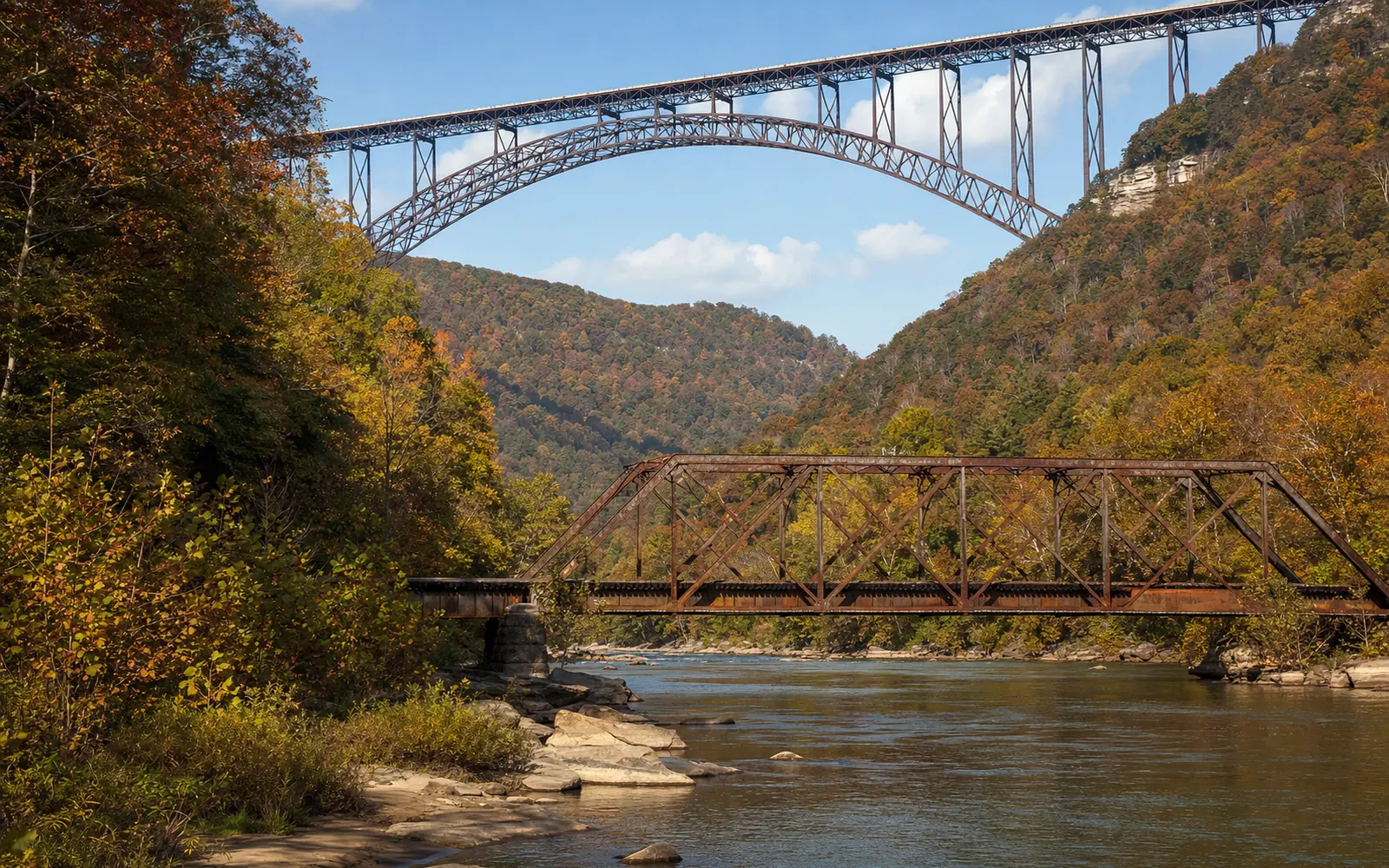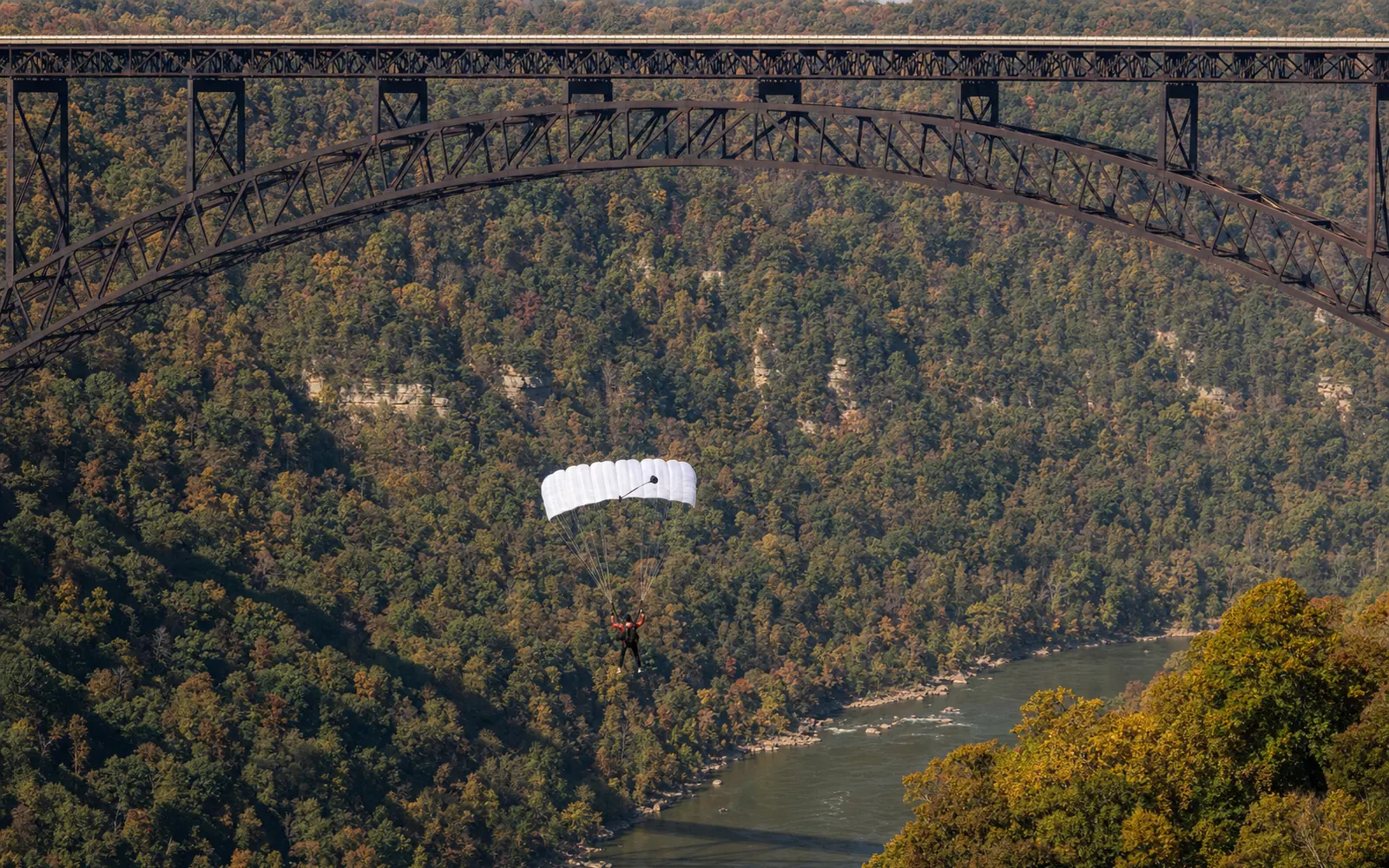
Stand at the Canyon Rim overlook and it's hard to believe anyone pulled this off. The New River Gorge Bridge was built from 1974 to 1977 by U.S. Steel's American Bridge Division and dedicated on October 22, 1977, a 1,700-foot steel arch carrying U.S. 19 876 feet above the river for about $37 million. Three years later, on November 8, 1980, came the first Bridge Day, inspired by a mine foreman named Burton Ervin who had parachuted off the bridge at night.
Before the arch, crossing the gorge meant the old Fayette Station route: down one wall, over the river on a little bridge and back up the other side, about 40 minutes of hairpins by the town's count. The bridge cut that to under a minute and changed which side of the gorge people could live, work and shop on. The West Virginia Encyclopedia has the fuller engineering story.
Why was the New River Gorge Bridge built?
People dreamed of it long before anyone paid for it. The earliest press item in the bridge's 2013 National Register nomination is a Fayette Tribune headline from September 13, 1956.
"Bridge to Link Oak Hill and Babcock Park Urged"
The bridge ended up as one piece of Corridor L, the Appalachian Development Highway link between I-79 near Sutton and I-64 near Beckley. Before 1967 the state had rejected a four-lane road down one side of the gorge and up the other, estimated at $65 million, as too expensive. In the spring of 1967 the State Road Commission hired Michael Baker, Jr., Inc. to design 11 miles of the corridor including the crossing, with Clarence V. Knudsen as chief bridge engineer. Engineers weighed suspension, truss and arch designs, and the arch won.
How the bridge was built, 1973 to 1977
On June 21, 1973 the contract went to American Bridge, which bid $33,984,000, nearly $7 million below the next bidder and 26 percent under the estimates. It was the largest contract the state highway department had ever let, and the final bill came to about $37 million.
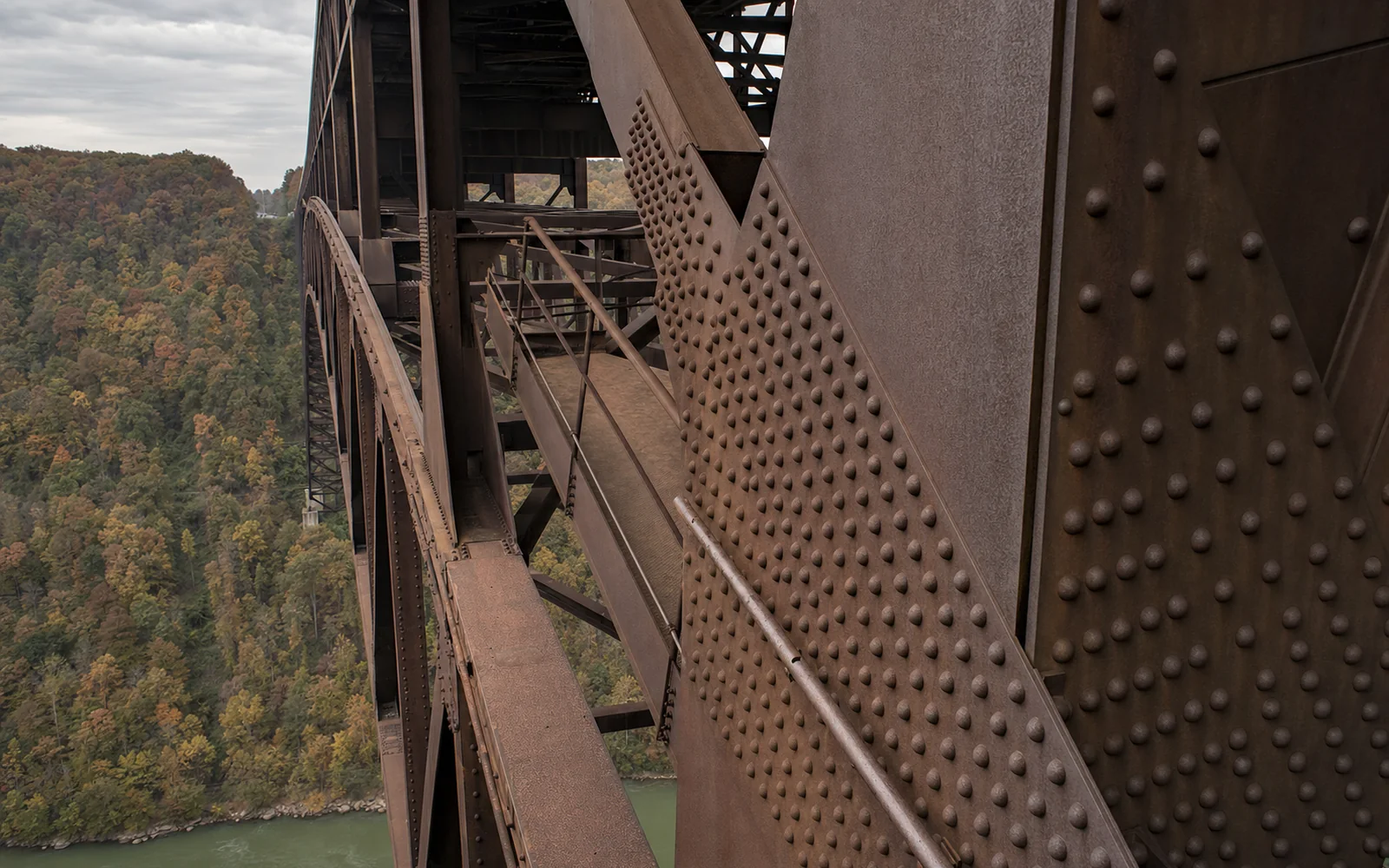
Ironworkers began the concrete supports for the columns in February 1974. On February 12 a helicopter strung four 5,000-foot, half-inch cables between 330-foot towers on each rim, and the first structural steel went up on June 14, 1974. That rusty brown you see is deliberate: the steel is U.S. Steel's COR-TEN B, fabricated at Ambridge, Pennsylvania, and at Gary, a weathering steel designed to rust instead of being painted. The highway department figured it saved $1 million every time the bridge didn't need a paint job. The catch, the nomination notes, is that with no paint to crack, inspectors check the steel by hammer and wire brush.
One man died building it. In May 1974 a temporary platform shifted and several ironworkers fell; Dan Snodgrass of Malden was killed and seven others were hurt, the nomination records from a Charleston Daily Mail report.
The bridge opened briefly in mid-October 1977 to carry hunting-season traffic, then was dedicated on October 22 before about 30,000 people. Sen. Jennings Randolph and Rep. Harley Staggers arrived by helicopter, Gov. Jay Rockefeller presided, and Charlie McCoy opened the noon ceremony by playing the national anthem on harmonica.
How long and how high is the bridge?
The bridge runs 3,030 feet end to end, with a 1,700-foot arch span and a deck 876 feet above the New River. The deck is 69 feet 4 inches wide (73 feet 5 inches to the outside of the parapets), and the whole structure weighs about 88 million pounds, with some 21,000 tons of structural steel.
From 1977 until China's Lupu Bridge opened in 2003, it was the longest single-span steel arch in the world. It now ranks seventh-longest among arch bridges and is the longest outside China, and it's often called the third-highest bridge in the United States. Traffic quadrupled between 1979 and 1994, reaching 26,000 vehicles a day by 2009. The bridge landed on West Virginia's state quarter in 2005 and a U.S. stamp in 2011, and Bridge Walk tours of the catwalk under the deck began in 2010.
It moved people, too. Between 1970 and 1980, Fayetteville's population grew more than 38 percent and Fayette County's 17.3 percent. In August 2013, at just 36 years old, the bridge went on the National Register of Historic Places under the rule for exceptionally important properties less than 50 years old; the state's register coordinator told MetroNews it had been put "on the fast track."
Far below the arch, the old crossing survives, and it's worth the drive. The Fayette Station bridge carries County Route 82 over the river and is named for Tunney Hunsaker, Fayetteville's police chief for 38 years, who lost to Cassius Clay in Clay's first professional fight on October 29, 1960. It sits on the Fayette Station Road loop, which passes beneath the arch for the best neck-craning view in the gorge. Viewpoints, catwalk tours and parking are on the New River Gorge Bridge page.
How did Bridge Day start?
With one illegal jump. Burton Ervin, an Army veteran and mine foreman from Webster County, parachuted from the bridge at night in August 1979, then set about creating a festival where jumping would be legal. The VFW's account puts it on August 17 at 10:20 PM, before about 200 onlookers. Ervin died in October 2017, around Bridge Day, at 82.
The Fayette County Chamber of Commerce held the first Bridge Day on November 8, 1980. Two parachutists landed on the deck from a plane, five jumped off the bridge and about 5,500 people walked across and went home with completion certificates, according to the organizer's history. The Park Service describes the event as a celebration of the bridge's October 1977 completion, and it now falls on the third Saturday of October.
It grew fast. The Legislature created the New River Gorge Bridge Day Commission in 1990 to guide the Chamber, with seats for the Chamber, the state Department of Transportation, the county commission, the State Police, the Town of Fayetteville and the sheriff. The milestones run from 28 rappellers and 10 parachutists in 1981 to 300 jumpers in 1984 and 400 in 1986, the first wedding on the bridge in 1990 and the first highline in 2002, the year the organizer dates the 7 AM to 5 PM closure of U.S. 19. The 2001 festival was cancelled after the September 11 attacks and replaced by a "Spirit of Bridge Day" downtown and the first Taste of Bridge Day. Bridge Day was cancelled again in 2020, when it went virtual, and in 2021, and it came roaring back in 2022.
How many people go to Bridge Day?
A lot, though nobody counts the same way twice. Estimates have ranged from about 80,000 to 200,000: a 1994 Park Service report said 200,000, the Associated Press about 100,000 in 2006, and for 2022 the Chamber's director said 120,000 while a Park Service district supervisor said about 140,000. The Fayette Tribune reported 82,000 for 2023, a syndicated report about 130,000 for 2024, and for 2025 the governor's office said more than 120,000.
The jump counts are firmer, and they're wild. On October 18, 2025, held during the federal shutdown, the organizer counted 315 BASE jumpers from 35 states and 4 countries, 752 jumps plus 16 tandems, 635 rappels, 50 ascents and 132 highline riders.
Has anyone died at Bridge Day?
Yes, and the jumpers take the risk seriously. The Park Service's administrative history says Bridge Day was nearly cancelled after a jumper died in 1983; he landed in the river and drowned after his parachute pulled him under, UPI later reported. On October 10, 1987, during the bridge's tenth-anniversary celebration, Steven Gyrsting, 26, of Paoli, Pennsylvania, died when his parachute failed to open, UPI reported. On October 21, 2006, Brian Lee Schubert, 66, of Alta Loma, California, died when his parachute began to open about 25 feet above the water; the AP called it the first Bridge Day fatality since 1987. In all, four BASE jumpers are reported to have died at the bridge, and news coverage from 2007 through 2025 reports no further Bridge Day death.
Bridge Day 2026: see it for yourself
Here's your chance to walk across the thing. The 47th Bridge Day is Saturday, October 17, 2026, from 9 AM to 3 PM, WOAY reported on September 16. U.S. 19 and the bridge close to traffic from 7 AM to 5 PM, which splits the gorge into two sides for the day, and spectators ride shuttles from lots in Fayetteville, Oak Hill and Hico. Tickets, lots, what you can bring and the rest of the logistics are on the Bridge Day 2026 page. How the gorge around the bridge became a national park is told in national river to national park.
Book your room early for Bridge Day weekend, and pick one on the same side of the gorge as your shuttle lot. The map below compares live prices for the nights of October 16 and 17.
Rooms near the bridge for Bridge Day weekend
Live prices for October 16 to 18, 2026. Pick a room on the same side of the gorge as your shuttle lot.
Live map from Stay22. The site may earn a commission if you book, at no extra cost to you.